Pompeii vs Herculaneum — Two Cities, Two Eruptions, Two Visits
Pompeii preserves the moment of death; Herculaneum preserves the moment of life. The 2026 comparison: tickets, crowds, size, the 79 AD October date shift, and the Vesuvius Challenge scroll breakthroughs.
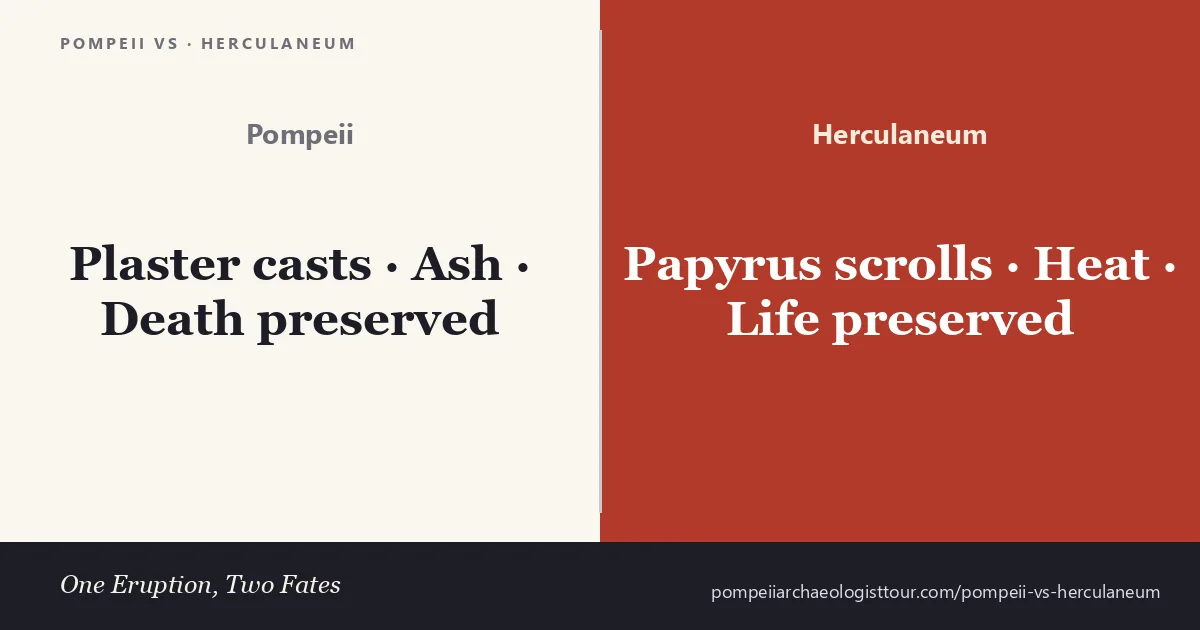
Pompeii preserves the moment of death; Herculaneum preserves the moment of life. That single sentence, drawn from how the two cities were buried, is the most useful frame for travellers choosing between them. Pompeii’s deep ash captured void-cavities of falling bodies and crushed buildings — Fiorelli’s plaster casts work because the ash sealed without burning. Herculaneum’s pyroclastic surge, fast and around 500°C in its first wave, carbonised organic matter rather than destroying it: wooden roof beams, doors, dining couches, foodstuffs in jars, and the ~1,800 charred papyrus scrolls at the Villa of the Papyri all survived where they would have rotted under Pompeii’s conditions. For visitors, the practical question is simpler: which one is worth your day? Here’s the comparison, with the 2024–2025 data that older articles miss. For the archaeologist-led Pompeii tour, Herculaneum is the obvious companion site for travellers with a second day.
Quick Comparison
| Pompeii | Herculaneum | |
|---|---|---|
| Size, total | ~66 ha (163 acres) | ~20 ha (49 acres) |
| Size, excavated | ~44 ha (~109 acres) | ~5 ha (~12 acres) |
| Burial | 4–6 m of ash + pumice | 16–25 m of pyroclastic surge |
| First surge temperature | n/a (ash fall) | ~500°C (first surge; 2023 Nature paper) |
| Preservation specialty | Plaster casts of victims | Carbonised wood, food, scrolls |
| Annual visitors (2024) | 4.07 million | 521,426 |
| Annual visitors (2025) | 4.00 million | 553,611 (+6.2% YoY) |
| Daily cap | 20,000 (since 15 Nov 2024) | None |
| Standard ticket (2026) | €20 | €16 |
| Reduced (EU 18–25) | €2 | €2 |
| Recommended visit | 3–4 hr highlights, full day completist | 2–3 hr |
| Summer hours | 09:00–19:00 (last entry 17:30) | 08:30–19:30 (last entry 18:00) |
| Winter hours | 09:00–17:00 (last entry 15:30) | 08:30–17:00 (last entry 15:30) |
| Closure days | 1 Jan, 1 May, 25 Dec | 1 Jan, 25 Dec |
Pompeii is one-eighth as busy in raw numbers — except Pompeii is also three times the size, so density evens out somewhat. Where Herculaneum genuinely wins is the post-2024 cap: Pompeii now turns walk-ups away in peak summer, while Herculaneum has never needed to.
The 79 AD Eruption — and Why the Date Changed
For 1,900 years, the eruption was dated to 24 August 79 AD, based on a passage in Pliny the Younger’s letters. In 2018, a charcoal graffito found at Pompeii reading “IDUS OCT” (17 October) shifted scholarly consensus. The graffito is recent (interpreted as having been written shortly before the eruption), and additional evidence — carbonised autumn fruits like figs, walnuts, and pomegranates, plus charcoal braziers in domestic use — supports an autumn date. 24 October 79 AD is now the date most current Italian archaeology cites; the August date is generally treated as a textual transmission error in surviving manuscripts of Pliny.
Both Pompeii and Herculaneum were buried in the same eruption, but by different mechanisms.
How the Two Were Buried (and Why It Matters)
Pompeii sat downwind. Volcanic ash and lapilli (small pumice fragments) fell on the city for hours, accumulating 4 to 6 metres deep before the heavier pyroclastic flows arrived at the end. People who didn’t flee suffocated or were crushed. When the ash compacted around bodies that later decomposed, void cavities remained — these are the famous Fiorelli plaster casts, made by pouring liquid plaster into the voids starting in 1863. The Garden of the Fugitives preserves 13 casts of a single family caught fleeing south.
Herculaneum sat to the west of Vesuvius, closer to the volcano and away from the prevailing wind. It wasn’t ash-buried — it was hit by pyroclastic surges and flows, hot dense currents of gas and rock that flowed downhill at high speed. A 2023 Scientific Reports paper refined the temperature of the first deadly surge to roughly 495–555°C, with subsequent flows progressively cooler. The depth of burial reached 16 to 25 metres.
The combination of high heat plus rapid burial plus anoxic conditions meant Herculaneum carbonised organic material instead of destroying it. Wooden roof beams. Wooden doors. Furniture. Foodstuffs. Textiles. And, most famously, papyrus scrolls — about 1,800 of them, found in the Villa of the Papyri excavations between 1752 and 1754. This is the only library to survive intact from classical antiquity.
The Vesuvius Challenge — Reading Scrolls With AI
The Villa of the Papyri scrolls were too carbonised to unroll physically without destroying them. For 250 years they sat readable only at their outer edges. In March 2023, computer scientists, papyrologists, and three software entrepreneurs launched the Vesuvius Challenge — a prize competition using machine learning and high-resolution X-ray imaging to “virtually unroll” the scrolls. Funding came primarily from the Musk Foundation, which has contributed roughly $2 million to date.
Recent breakthroughs:
- February 2025: First images of the interior of scroll PHerc. 172 (held at the Bodleian Library, Oxford) were generated. The world saw inside a Herculaneum scroll for the first time in nearly 2,000 years.
- May 2025: X-ray scans revealed the title and author of a complete charred scroll — Philodemus, On Vices. Philodemus was the Epicurean philosopher whose library the Villa of the Papyri is thought to have housed.
The Villa of the Papyri building itself is currently closed to general visitors for excavation, accessibility, slope-restoration, and water-management works. Most of the building remains buried. Occasional guided “Close-up Cantieri” tours open the Scavi Nuovi trench but there is no regular walk-in access. Visitors can see the scrolls’ digital reconstructions and follow Vesuvius Challenge progress at scrollprize.org.
What You Actually See at Herculaneum
The Herculaneum site is smaller and tighter than Pompeii, which is good for a half-day visit. Highlights for a 2–3 hour walk:
- Boat Houses (Fornici) — vaulted chambers along the ancient seafront where ~300 victims sheltered during the eruption; skeletons still in situ
- House of the Wooden Partition — the partition is original carbonised wood
- Bottega ad Cucumas — wine shop with preserved jars and frescoed prices on the wall
- House of the Deer — luxurious seaside villa with original statuary
- House of the Mosaic of Neptune and Amphitrite — vivid wall mosaic above the dining couches
- Casa del Bicentenario — note: closed for major maintenance until 17 April 2026
The site entrance opens onto an elevated walkway from which you look down into the excavated city. The ancient coastline — where the Boat Houses now sit — is around 400 metres inland from today’s shoreline because the pyroclastic flows pushed the sea back.
Tickets and Combined Options
There is no official Ministry of Culture combined Pompeii + Herculaneum ticket. The closest thing is the Campania Artecard (about €42 for the 3-day pass), which covers both archaeological parks plus Naples museums plus regional transport including the Circumvesuviana. Third-party reseller “combo” packages exist around €20–€25 but they’re not a ministry ticket — they’re two separate tickets bundled with a small reseller markup.
The Pompeii Plus ticket (€30, 3-day) covers Pompeii plus Oplontis, Stabiae, and Boscoreale — sites managed by Pompeii Sites — but not Herculaneum, which is a separately administered park.
Herculaneum’s standard ticket is €16. A temporary exhibition called “From the Egg to Apples” is currently bundled in for €19 — verify which version applies on the day you visit.
Pompeii + Herculaneum in One Day — Yes, Easily
The two sites are 20 minutes apart by train on the same Circumvesuviana line. From Pompei Scavi-Villa dei Misteri, take a Naples-bound train to Ercolano Scavi (~15–25 min, ~€2 one-way). The station is a 5–8 minute walk downhill from the Herculaneum park gate.
Standard one-day pairing:
- Morning at Herculaneum (smaller, less crowded, 2–3 hours) — Boat Houses, House of the Wooden Partition, Bottega ad Cucumas, House of the Deer
- Lunch in Ercolano or back on the train
- Afternoon at Pompeii (focused 3–4 hours) — Forum, Lupanar, House of the Faun, Stabian Baths, theatres, Garden of the Fugitives
Reverse order works too — but Pompeii mid-afternoon crowds peak in summer, so a 9 AM Pompeii start is the alternative. For full one-day planning, see Pompeii in one day. For transport, see how to get to Pompeii.
Which One for Whom?
| You are… | Pick |
|---|---|
| First-time visitor with one day | Pompeii — the bigger story, the famous casts |
| First-time visitor with two days | Both — Herculaneum morning + Pompeii full day, or one-day combo |
| Sensitive to crowds | Herculaneum — one-eighth the volume |
| Interested in Roman daily-life detail (wood, food, textiles) | Herculaneum |
| Travelling with limited mobility | Pompeii has the longer accessible route, but Herculaneum is smaller and more contained |
| Want the most famous things | Pompeii — House of the Faun, Lupanar, plaster casts |
| Cruise day-tripper | Pompeii alone if 4–5 hr port window; both if 8+ hr |
Ready to Book?
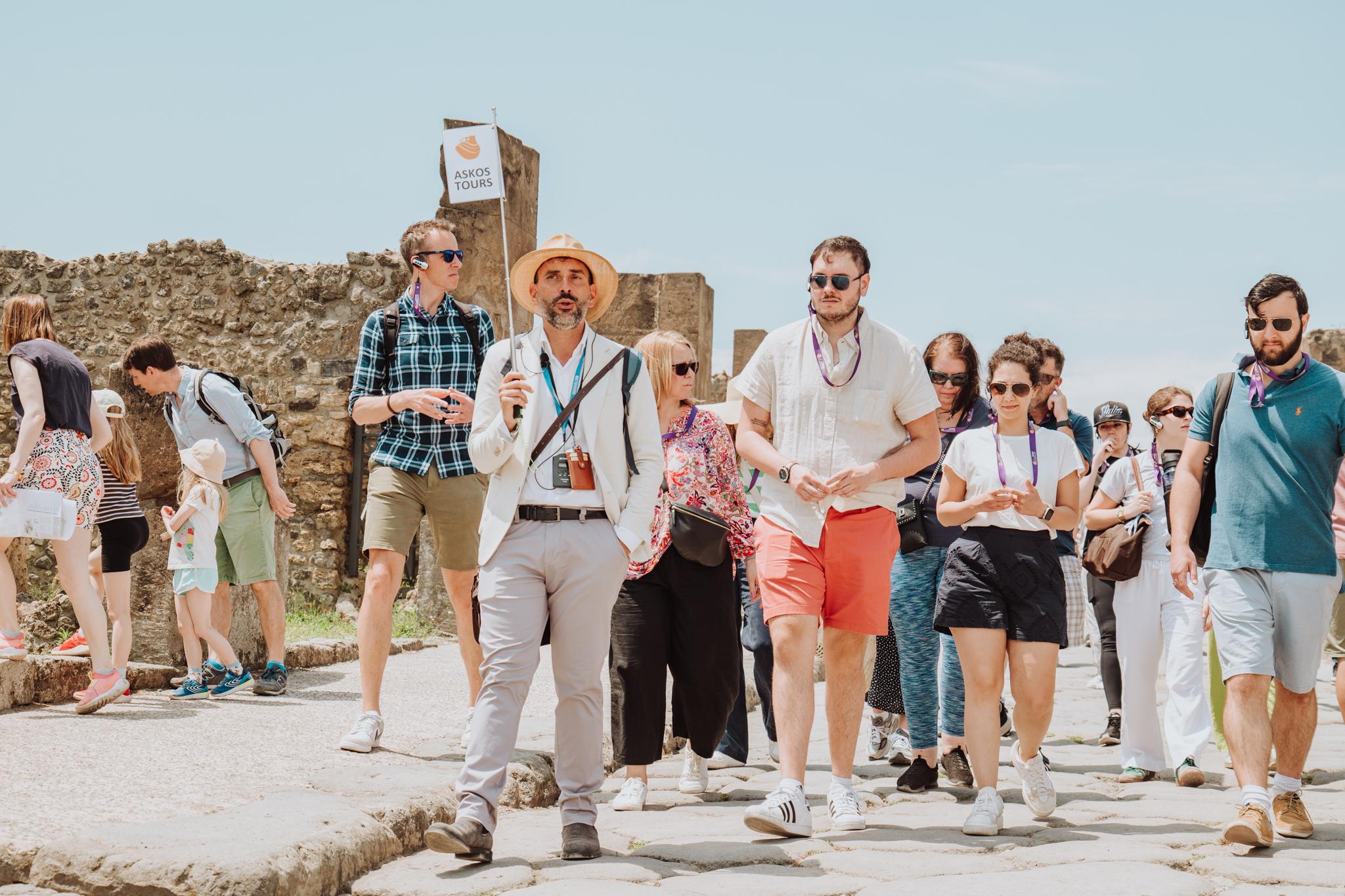
The featured 2-hour Pompeii archaeologist tour handles the headline site — skip-the-line entry, working archaeologist guide, max 20 people. If you’re combining with Herculaneum, take the tour as your Pompeii morning and continue self-guided to Herculaneum in the afternoon. Rated 4.8/5 by 23,547+ verified travellers, with free cancellation up to 24 hours before. Check availability and book →
Ready to Walk Pompeii With an Archaeologist?
The top-rated Pompeii archaeologist tour — skip-the-line Pompei Express entry, 2 hours with a working archaeologist through the Forum, Lupanar, House of the Faun, plaster casts and the theaters. Small group of 20, headsets included. From $34 per person with free cancellation up to 24 hours before.
Check Availability & Book